Jyotish / Varsha Pravesh

Varsha Pravesh
Straightforward calculation
of your annual chart

The annual chart by the Tajika classics: an honest balance of the year's forces, and the solar-return moment accurate to the arc-second.

What is Varsha Pravesh

The Vedic counterpart of a solar return: the chart cast for the exact moment the Sun comes back to its natal position.

The solar return

Every year the Sun returns to exactly the position it held at your birth. The chart cast for that moment is called Varsha Pravesh — in Sanskrit, "the entry of the year".

It is not a "birthday chart" — the return may fall a day before or after your birthday. The precision of the calculation is critical.

The Tajika method

Tajika Jyotish is a branch of Vedic astrology devoted to annual forecasting. It has its own yogas (Ithasala, Ishrafa, Nakta and others), the Muntha system and its own planetary periods (Mudda dasha).

Dharmika calculates all 16 Tajika yogas and shows their influence on each sphere of life.

Why precision is critical

A four-minute error in the solar-return moment can shift the lagna (the rising sign) of the annual chart. That changes the whole interpretation. Dharmika uses the Newton-Raphson method, accurate to 0.001 of an arc-second.

What the report includes

A full analysis of the annual chart by the Tajika method.

Newton-Raphson

An iterative numerical method for finding the exact moment the Sun returns to its natal longitude. Accuracy: 0.001 of an arc-second. Swiss Ephemeris DE441.

16 Tajika yogas

A full calculation of every Tajika yoga of the annual chart, interpreted by sphere of life.

Ithasala — application (success)
Ishrafa — separation (parting)
Nakta — the transfer of light
+ 13 more yogas

Mudda dasha

The planetary periods of the annual chart. Each planet rules a stretch of the year. Knowing the periods shows when exactly the year's tendencies unfold.

Example periods
Sun 12 Aug — 22 Sep
Moon 22 Sep — 2 Nov
Mars 2 Nov — 12 Dec
... ...

Muntha

A progressive point, moving one sign a year. Muntha's position in the annual chart and its aspects are a key factor in the Tajika analysis.

Sahams (Arabic parts)

Sensitive points calculated for each sphere of life: Punya saham (merit), Vidya saham (knowledge), Vivaha saham (marriage) and others.

A classical package, not a single chart

An annual chart alone says little. The Tajika school reads the year through planetary strengths, the Lord of the Year and the periods — all computed from the primary source, the Tajika-Nilakanthi, rather than from summaries of it.

Lord of the Year

Five candidates, and you can see why this one was chosen

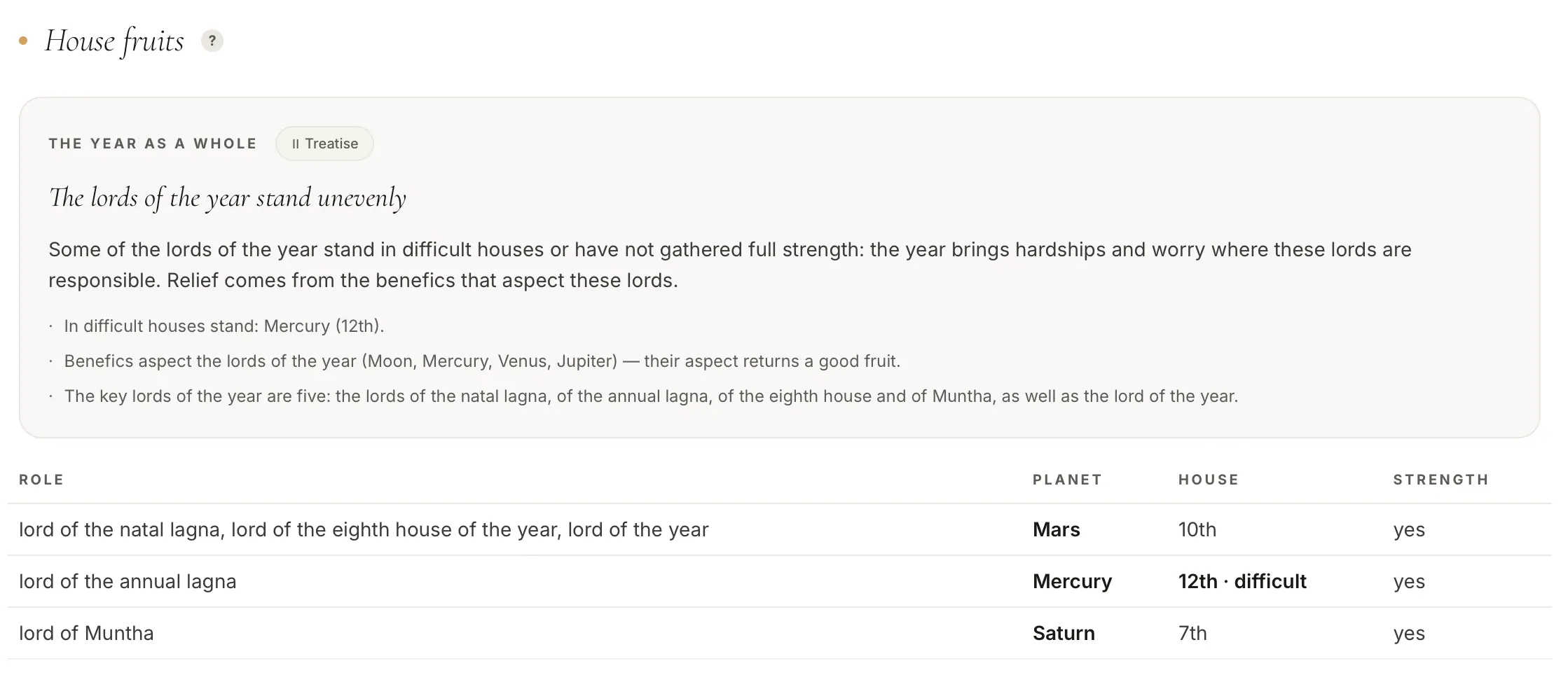
Five adhikaris: the lords of the natal and annual lagnas, of Muntha, the trirashipa and the lord of the Sun's sign by day or the Moon's by night. The Lord of the Year is the strongest by Panchavargiya bala — but only among those that aspect the annual lagna. A table of all five stays on screen: role, strength, aspect to the lagna. A strong planet that does not aspect is honestly marked "does not aspect" rather than quietly dropped.

Two strengths, kept apart

Panchavargiya bala (five dignities) and Harsha bala (four rules of joy) are not added into a single score — they are different scales, and mixing them would invent a third.

The year's periods

Patyayini — the treatise's own way, eight periods. Mudda is the familiar dasha, but it comes from the publisher's appendix, and we label it as such rather than passing it off as the root text.

The year's verdict — without prophecies

The verdict names the count of strong and weak planets, the strongest stretch of the year and the grounds for it — and promises no events. Favourability is computed by Ishta/Kashta, and right next to it we say plainly that this is Parashara's layer, not Tajika's: the Ishta/Kashta formula does not appear in the Tajika-Nilakanthi at all — we checked, and wrote that, instead of passing another school's scale off as this one's classics.

The year's tape

Twelve monthly charts inside the year

Masa pravesha: every month has its own chart, its own Muntha and its own lord — Masesha is chosen from six adhikaris by strength and aspect to the month's lagna. A click on a month opens its chart, the candidate table, the dasha and the fruit of that month. You see not "what kind of year this is in general" but when exactly things take shape.

Tri-Pataki chakra

An 18-line scheme built from the year's lagna: who "pierces" the Moon and from where. The reading is concrete — drawn from your chart, ending in a plain-language conclusion.

Fruits — translated from the treatise, not paraphrased

The fruits of the Lord of the Year, Muntha, the periods, the houses and the months are translated from the shlokas of the Tajika-Nilakanthi and stand beside their own calculation. Every text carries a basis chip: a verbatim shloka, an addition to the treatise, or the later tradition. Where the source is silent, we say so, instead of inventing a text.
The 'Lord of the Year — why him' analysis: a table of five adhikaris with their roles, Panchavargiya bala strength and aspect to the annual lagna

36 sahams, Tajika aspects, a friendship scheme of your choice

Aspects follow the Tajika shlokas (3/5/9/11 — friendly, the kendras — hostile, 2/6/8/12 do not aspect at all), and the friendship scheme switches: positional by the annual chart, Tajikasara's fixed one, or natural. Switching the scheme honestly changes the Lord of the Year — you can see it happen on screen.
"Expert" plan · $19/mo

A sample annual chart

This is what a Varsha Pravesh report looks like in Dharmika.

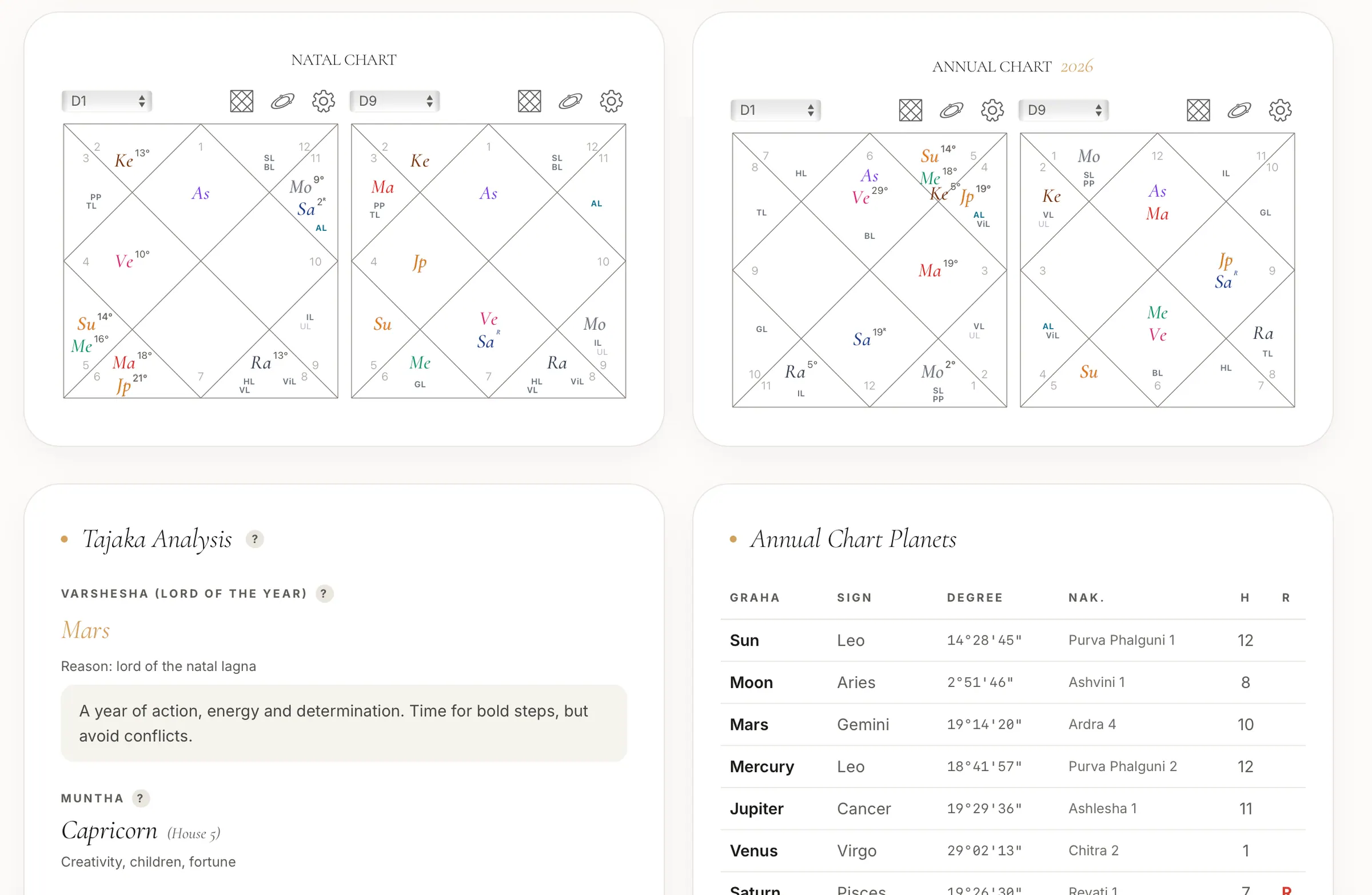
Varsha Pravesh 2026–2027 · a real calculation
The Sun returns to its natal position: 01.10.2026, 10:30:54
The moment is computed to the second — for your chosen city
The 2026 annual chart in Dharmika: rashi D1 and navamsha D9
The year's lagna
Libra
The ascendant of the solar-return moment
Muntha
Libra
1st house — yourself, your well-being and personal initiatives
Varshesha (Lord of the Year)
Mercury
A year of communication, learning and commerce — study, trade, negotiations
Why Mercury became the Lord of the Year
The rule of selection: the strongest by Panchavargiya bala among those aspecting the annual lagna; there are five candidates. Here Venus carries four roles at once — the lord of the natal lagna, of the annual lagna, of the eighth house and of Muntha — and still yields: the report shows every candidate's strength and aspect.
Tri-Pataki chakra: the year's Moon is pierced by the Sun
The Sun in Virgo stands on one line of the chakra with the Moon in Taurus: along the line of well-being, the year is more taxing than usual — it is sensible to rest earlier and not to let fatigue accumulate.
The strongest stretch of the year — Jupiter's period
31 May — 21 September 2027, 113 days: among the period lords Jupiter is at full strength by Panchavargiya bala — 16.6 out of 20.
Mo
Ma
Ra
Ju
Sa
Me
Ke
Ve
Su
Moon remainder1 Oct — 22 Oct
Mars22 Oct — 12 Nov
Rahu12 Nov — 6 Jan
Jupiter6 Jan — 24 Feb
Saturn24 Feb — 23 Apr
Mercury23 Apr — 13 Jun
Ketu13 Jun — 5 Jul
Venus5 Jul — 3 Sep

Then the Sun (3-22 September) and the Moon (22 September — 1 October), up to the next solar return. The first dasha is shown as its remainder (bhogya).

This is only the top layer. The full report has: the 12-month tape with each month's chart and lord, the fruits by house translated from the shlokas, 36 sahams, planetary strengths by Panchavargiya and Harsha, the table of five candidates for Lord of the Year — and for each one you can see why the choice came out as it did.

Frequent questions

The principle is the same — a chart for the moment the Sun returns to its natal position. The interpretation is fundamentally different: Tajika uses its own yogas (16 types), Muntha, Mudda dasha and sahams. It also uses the sidereal zodiac instead of the tropical one, which places the planets differently.

Yes, for Varsha Pravesh an exact birth time is critical. Even a small inaccuracy in the natal position of the Sun leads to an error in the solar-return moment, and therefore to a wrong lagna of the annual chart. Recommended accuracy: within 5 minutes.

The Varsha Pravesh chart is cast for the city where you are at the moment of the solar return (your "astrological birthday"). If you have moved, use your current city. Dharmika can cast the chart for any point in the world.

Newton-Raphson is the mathematical method Dharmika uses to find the exact moment of the solar return. Many programs use linear interpolation, which is less accurate. The difference can amount to several minutes — enough to shift the lagna of the annual chart, and with it the whole interpretation.

Build the annual chart

Newton-Raphson. Tajika yogas. Mudda dasha. Accuracy to 0.001 of an arc-second.

Build the annual chart